Latest Blog Posts
-

-

-

-

-

-

-

-

-

Why Successful Local Brands Fail When Scaling
May 25, 2026
-

Aug 18
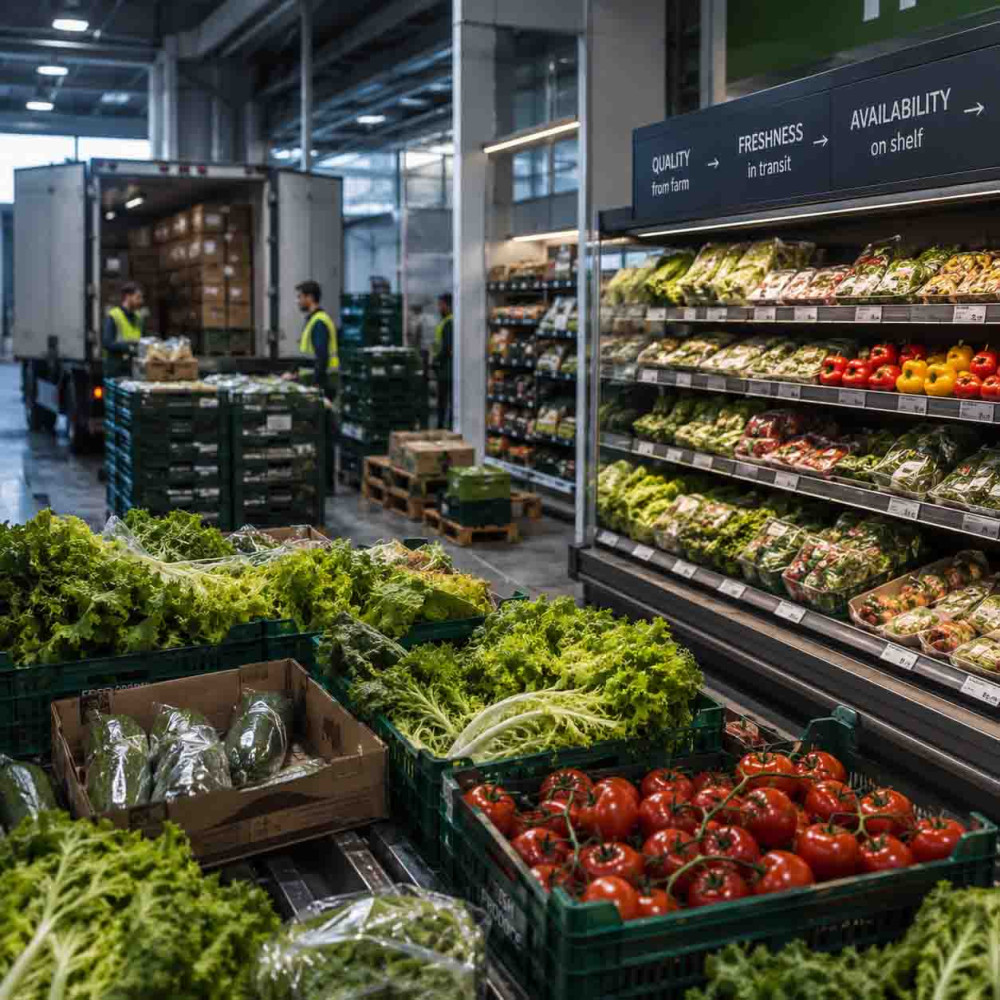
Hidden Losses: Where Fresh Produce Businesses Lose Up to 30% of Their Profits Without Realizing It
Introduction
Why can a fresh produce business show stable sales and still fail to generate sufficient profit? In practice, this is one of the most common situations in the category. Sales volumes are there, the product is selling, shelf space is secured, yet the final margin turns out to be lower than expected. The problem is that a significant share of losses is not recorded as direct financial damage and is therefore not perceived as critical.
In 2026, the fresh category is becoming an increasingly complex system in which profit is shaped not only by price and production costs, but also by the details of operational processes. Losses do not occur in one single place; they are distributed throughout the entire chain, from production to the retail shelf. This is why businesses often fail to see exactly where they are losing money and continue operating under a model that appears stable but gradually becomes less efficient.
Why the Main Losses Remain Invisible
Fresh produce businesses traditionally focus on sales and volume indicators, which creates an illusion of control. If the product is selling, the assumption is that the business model is working. However, this approach does not take into account hidden losses that may not directly affect revenue but still reduce profitability.
These losses are spread across different stages and are rarely consolidated into a single picture. Some occur during production, others in logistics, and others at the retail level. Because they do not appear as direct losses, businesses often fail to recognize them as a problem.
As a result, a company may continue to demonstrate stable turnover without realizing that its actual efficiency is declining. This becomes especially critical when costs are rising, because even relatively small losses can begin to have a significant impact on margins.
Production Losses: Where Margin Erosion Begins
At the production stage, the main losses are associated with inefficient use of resources and process instability. This may include excessive consumption of water, energy, or fertilizers, as well as quality deviations that result in a lower selling price.
A lack of precise control and analytics makes these problems more severe. Producers do not always know exactly how many resources are being used per unit of output or where excessive consumption is occurring. This makes production costs harder to manage and increases the risk of margin erosion.
Yield variability creates additional pressure. Inconsistent output complicates planning and leads to fluctuations in supply, which then affect the entire downstream chain.
Logistics: The Main Area of Hidden Losses
At the logistics stage, losses become more visible, but they are still often underestimated. Delays, improper storage, and poorly synchronized deliveries lead to deterioration in product quality and higher write-offs.
The problem is not always caused by one single factor. More often, it is a combination of small deviations that together have a significant impact. For example, a slight increase in delivery time, minor temperature-control errors, and inaccurate volume planning can collectively lead to substantial losses.
In the fresh category, logistics directly affects profitability because it determines the condition in which the product reaches the shelf and how much of it can ultimately be sold.
Losses at Shelf Level: Where Businesses Lose Money Without Seeing It
Even when a product is produced and delivered efficiently, a significant share of losses can still occur at the retail level. Poor shelf placement, low visibility, and a lack of in-store support reduce sales and increase unsold inventory.
In an overcrowded assortment, a product that does not attract customer attention effectively does not participate in the sale. This leads to lower inventory turnover and higher write-offs, which are not always associated with management errors.
Pricing strategy also has a significant impact. Incorrect product positioning can reduce demand and lead to additional promotional activity, which further erodes margins.
Gaps Between Stages: The Main Source of Systemic Losses
The key problem lies not in individual losses, but in the lack of coordination between different stages. Production, logistics, and sales often operate independently, which creates misalignment across the chain.
For example, increasing production volumes without considering logistics capacity can create excess inventory. Conversely, optimizing logistics without taking the specific characteristics of the product into account can reduce product quality. These gaps generate systemic losses that are difficult to identify because they are distributed across multiple processes.
As a result, businesses manage individual functions but fail to manage the system as a whole, and this becomes one of the main reasons for declining efficiency.
Why Technology Is Becoming a Tool for Identifying Losses
The key role of technology in 2026 is not automation itself, but its ability to make losses visible. Before analytical systems are implemented, a significant share of deviations remains hidden because data is fragmented and disconnected. Production tracks its own metrics, logistics tracks its own, and retail tracks its own, but there is no integrated view. As a result, businesses manage processes without understanding exactly where profit is being lost.
Technology makes it possible to combine these data streams and identify cause-and-effect relationships. For example, a decline in shelf quality may be linked not to production, but to logistics delays, while unstable sales may be caused by product variability originating at the growing stage. Without end-to-end analytics, these connections are difficult to identify, and decisions are made based on assumptions rather than facts.
This changes the entire management approach. Businesses move from reacting to consequences to managing underlying causes. Losses stop being viewed as unavoidable costs and become a parameter that can be monitored and reduced. However, this requires more than simply implementing technology. It also requires a change in approach: data must be used to support decision-making rather than merely recorded. Otherwise, the system remains a formality and has no meaningful impact on business economics.
Where Businesses Lose the Most
The largest losses do not occur within individual operations, but at the intersections between processes where synchronization is missing. This is where gaps arise between planning and actual execution, leading to the accumulation of inefficiencies. These losses are difficult to identify because they are distributed across the business and do not have one obvious point of origin.
In practice, the main areas where losses accumulate are linked to mismatches between production volumes and actual demand, errors in supply planning, and the absence of unified quality control across all stages. Additional pressure comes from misalignment between retailer expectations and producer capabilities, which leads to returns, write-offs, and additional promotional costs.
Importantly, these losses do not appear critical when viewed individually. Each deviation may seem minor, but together they can cause a significant decline in profitability. This is why businesses often underestimate their impact and continue operating within a model where profit gradually decreases without any obvious crisis.
Fresh Produce Business as a System of Control, Not Just Sales
The key shift is that the fresh produce business is no longer a linear chain and is becoming a managed system in which profitability is created through the interaction between processes. Production, logistics, and sales can no longer be viewed separately because the efficiency of each stage depends on how well it is aligned with the others.
In this model, the main object of management is not the product itself, but the flow: how it is created, moved, and sold. Controlling this flow makes it possible to reduce variability, minimize losses, and improve the predictability of results. This is what becomes the foundation of sustainable margins.
Companies that adopt this approach begin managing the system as a whole rather than simply reacting to consequences. They can see where profit is generated and where it is lost, and they can influence those points directly. Companies that continue to focus only on sales and volumes remain in a position where results depend on external factors rather than on the degree of operational control. In the conditions of 2026, this is becoming a key constraint on growth.
Your experience matters! Take a short survey and see how others answered. Take part