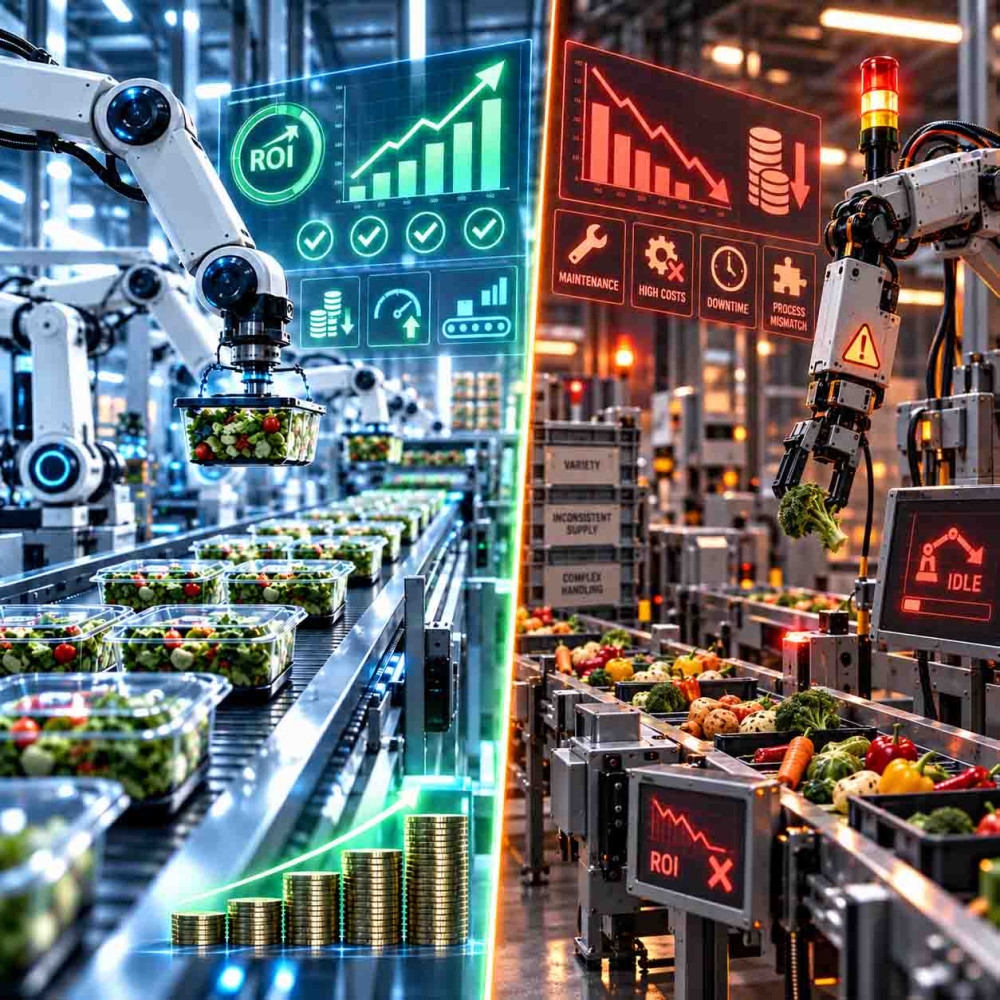
Where Automation Pays Off — and Where It Doesn’t

Sep 18

Automation Without Illusions: Where Robots Really Pay Off — and Where They Don’t

Introduction

Automation has become one of the most widely discussed areas in the food industry, but in 2026 there is still a significant gap between expectations and real-world economics. Many companies view robots and automated lines as a universal solution for improving efficiency, reducing costs, and increasing margins. In practice, however, automation does not guarantee a return on investment and, in some cases, can even increase the financial burden on a business.

The problem is that automation is often perceived as a technological improvement rather than as an investment project with a clear economic model. As a result, decisions are made without a full understanding of where value is actually created and what drives the return on investment. This leads to a situation in which some companies gain a sustainable advantage, while others face rising costs and reduced flexibility. In 2026, automation is no longer a question of “whether it is needed or not,” but rather “where and under what conditions it actually works.”


Why Automation Does Not Always Reduce Costs

A common expectation is that introducing robots automatically leads to lower costs by reducing staffing needs and increasing efficiency. In practice, this effect is achieved only under certain conditions, because automation itself creates new cost categories. Capital investment, equipment maintenance, integration into existing processes, and dependence on technical infrastructure create an additional burden that is not always offset by savings.

One of the specific characteristics of the fresh and food market is the high variability of products and processes. Unlike standardized manufacturing, these sectors often require a degree of flexibility that automated systems are less capable of providing. If a system is not adapted to real operating conditions, it can begin to reduce efficiency rather than improve it. This creates a paradoxical situation in which automation increases management complexity without delivering the expected economic effect.

Scale also plays an important role. When operational volumes are insufficient, the fixed costs of automation are spread across a limited amount of output, making unit costs higher than under manual operations. This means that automation works only within certain business models and is not a universal solution.


Where Automation Really Pays Off

Automation delivers the greatest economic effect in processes with a high degree of repetition and predictability. Where operations are standardized and volumes are stable, automated systems can reduce costs and increase productivity without sacrificing quality. Under these conditions, investment costs are spread across a large volume of output, accelerating the payback period.

The key factor is not automation itself, but how well it matches the structure of the process. If an operation can be described as a sequence of repetitive actions with minimal variability, robotics can reduce the impact of human error and lower the likelihood of mistakes. This is especially important in tasks where accuracy and speed have a direct impact on unit cost.

An additional advantage appears in situations where there is a shortage of labor or rising labor costs. In such cases, automation becomes not only a cost-reduction tool but also a way to ensure operational stability. It allows companies to maintain production processes with less dependence on external factors, which is especially important for large-scale and scalable operations.


Where Automation Does Not Work and Creates Losses

Automation becomes less effective in highly variable processes where products or operating conditions change constantly. This is particularly noticeable in the fresh category, where products differ in size, shape, and quality, requiring a high degree of flexibility. Under such conditions, robotic systems face limitations and may be unable to deliver consistent results.

Problems also arise when volumes are unstable. If equipment utilization fluctuates, investments may fail to pay off because the system is not used at full capacity. This increases unit costs and reduces efficiency. Unlike manual labor, which can be scaled up or down, automation requires a consistently high workload to remain economically justified.

Integration complexity is another factor. If automation is introduced without changing existing processes, it can begin to conflict with the current system. This increases operating costs and reduces controllability. As a result, the business does not gain optimization but instead adds another layer of complexity.


Payback as the Key Criterion, Not the Technology

The main mistake businesses make is evaluating automation from a technological rather than an economic perspective. Decisions are based on what the equipment can do instead of how it affects financial performance. This leads to investments that lack a clear return model.

The payback of automation depends on several factors: operational volume, level of standardization, labor costs, and the ability to integrate the system into business processes. Without taking these parameters into account, it is impossible to determine whether a project will be effective. It is important to understand that automation is not inherently a cost-reduction tool; it is a way of redistributing costs.

In 2026, successful automation projects are built not around technology but around business logic. Companies begin by analyzing processes, identifying the areas where losses are highest, and only then introducing solutions. This helps avoid investments that do not create value.


The Impact of Automation on Business Flexibility

One of the key consequences of automation is a change in the level of business flexibility. Robotic systems increase efficiency under stable conditions but reduce the ability to adapt quickly to change. This becomes a critical factor in dynamic markets where demand and operating conditions may shift rapidly.

Businesses face a trade-off between efficiency and flexibility. Automation strengthens the former but limits the latter. This means that decisions must take into account both the company’s strategy and the characteristics of the market. In some cases, preserving flexibility may be more profitable than maximizing optimization.

It is also important to consider that automation tends to lock processes into a fixed structure. Any changes require additional time and investment, which can slow down a company’s response to the market. This makes automation effective primarily in segments where conditions are relatively stable.


Where Businesses Lose Money When Introducing Robots

The main losses arise not from the technology itself but from the wrong approach to implementation. Companies invest in automation without analyzing processes, fail to consider actual volumes, and ignore system limitations. As a result, the expected effect is not achieved.

The most common mistakes include:

• implementation without understanding the payback period

• automating unstable processes

• underestimating maintenance costs

• lack of integration with other stages of the process

These factors create a situation in which automation not only fails to reduce costs but actually increases them. The business ends up with technology that does not fit its operating model and is forced to adapt itself around the technology.


Automation as a Tool, Not a Strategy

The key conclusion is that automation is not a standalone development strategy. It works only as a tool integrated into a broader management system. Its effectiveness is determined not by the level of technology itself but by how precisely it matches the business model.

In 2026, the companies that perform best are those that treat automation as part of overall business economics rather than as a separate direction. They invest selectively in the processes where the impact is clear and avoid excessive technologization. This allows them to maintain a balance between efficiency and flexibility.

Those that view automation as a universal solution face rising costs and reduced controllability. That is why the key question is no longer “should we automate?” but “where does automation actually create profit?”

Your experience matters! Take a short survey and see how others answered. Take part