Audio version
Introduction
Why do some fresh produce growers generate stable profits while others, operating at the same production volumes, work with minimal margins or even lose money? Increasingly, the answer lies not in the product, the price, or even demand, but in how the production and management system itself is structured. In 2026, the greenhouse market is no longer primarily about availability; it is becoming a story of efficiency, where the key factor is the ability to control every stage — from cultivation to delivery.
The first wave of greenhouse development solved the problem of seasonality and turned fresh produce into a year-round category. However, this solution also created a new reality: the market stopped being supply-constrained, availability became stable, and competition became constant. As a result, the main source of margin in the past — product scarcity — disappeared. It was replaced by pressure from retail, rising costs, and the need to manage economics more precisely. In this system, technology is no longer simply a competitive advantage; it becomes a foundation for survival, because it is what allows producers to maintain margins in an environment where pricing power no longer belongs to them.
Why Production Growth No Longer Generates Profit
The logic of scaling, which for a long time was fundamental to agricultural production, is no longer working under current conditions. Previously, increasing volumes meant expanding the market, securing shelf space, and creating a stable flow of sales. Today, additional volume does not create new demand; it only intensifies competition within an already established category. This leads to systematic downward pressure on prices and makes each additional kilogram of product less profitable than the previous one.
In a saturated market, retailers gain the ability to choose suppliers not based on product availability, but on commercial conditions. These include price, supply stability, predictable quality, and willingness to participate in promotions. Producers find themselves in a position where they cannot compensate for rising costs by increasing prices because their products are becoming interchangeable. In such a system, increasing production without simultaneously improving efficiency leads to lower margins.
At the same time, a “hidden overproduction” effect emerges, in which volumes remain high, but a significant share of the product is sold at minimal margins or written off entirely. This is not always visible in revenue figures, but it directly affects profit. As a result, the market begins to divide into two groups of players: those who manage efficiency and preserve margins, and those who focus on volume while gradually losing profitability.
Where Profit Is Created: Not on the Shelf, but in the System
Traditionally, profit is seen as being created at the point of sale, where the selling price exceeds the cost of production. In the fresh produce category of 2026, however, this is only the final stage, influenced by dozens of parameters. Production costs, losses, quality consistency, logistics speed, and compliance with retailer requirements shape the final financial result long before the product reaches the point of sale.
The main challenge is that a significant share of losses is not recorded as direct financial losses. They appear through slower inventory turnover, declining quality, the need for additional promotions, and unstable deliveries. Combined, these factors reduce margins even when sales remain at the same level. A business may show stable revenue while failing to notice that its profit is gradually shrinking.
The key areas where margin is created or lost include:
• efficiency of resource use in production
• stability and predictability of yields
• the level of write-offs and losses in logistics
• the ability to meet retailer requirements without additional costs
The problem is that these areas are often managed separately. Production, logistics, and sales operate as independent functions that are not synchronized with one another. As a result, the system loses efficiency, and part of the profit “leaks” between stages. This is precisely where technology begins to play a critical role by bringing processes together into a single, manageable model.
How Technology Turns Production Into a Manageable Economic System
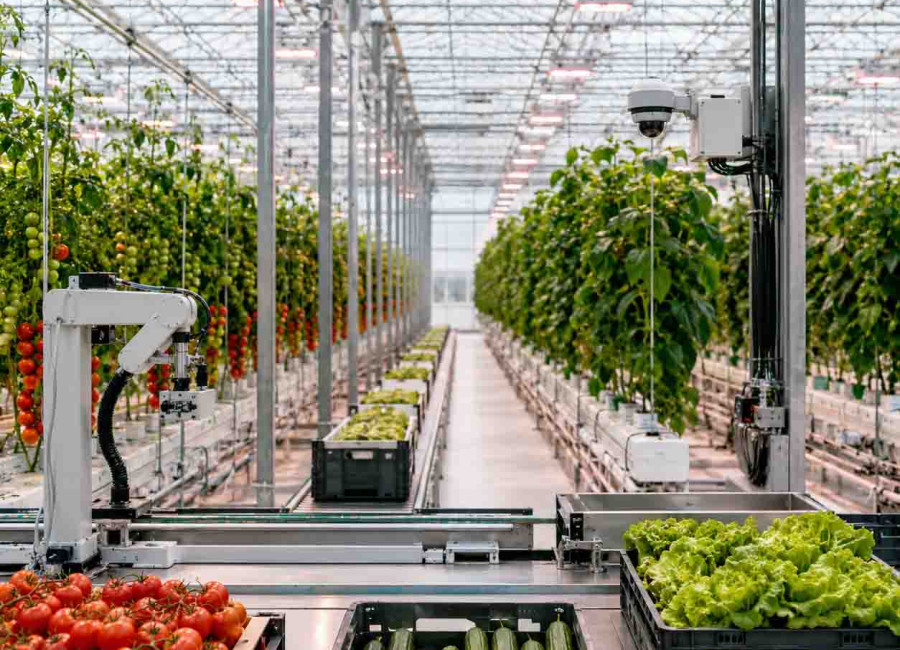
Modern greenhouse technologies change not only the way products are grown, but also the underlying principles of business management. They make it possible to move from a reactive model, in which the producer responds to changes after they occur, to a proactive one, where key parameters are controlled in advance. This is especially important in an environment where even small deviations can lead to significant financial losses.
Monitoring systems track key environmental parameters and allow them to be adjusted in real time. This reduces the influence of random factors and makes the process more predictable. Producers gain the ability to plan volumes, quality, and delivery schedules in advance, which is critical when working with retail. As a result, production stops being a collection of variables and becomes a manageable system.
In practice, this means:
• precise control of microclimate and growing conditions
• optimization of resource consumption without compromising quality
• reduced product variability
• the ability to forecast results
These changes directly affect the economics of the business. Lower uncertainty reduces risk, while greater predictability allows costs and revenues to be planned more accurately. As a result, technology begins to function not merely as an improvement tool, but as the foundation of financial stability.
Production Cost as the Main Factor of Survival
Rising costs are becoming a key challenge for the fresh produce category. Energy, resources, and logistics are becoming more expensive, while opportunities to increase prices remain limited. Under these conditions, managing production costs becomes a central business priority. However, unlike in earlier periods, when cost reduction was achieved mainly through scale, today it requires targeted optimization.
Technology makes it possible to manage production costs at a granular level. Automation reduces dependence on labor and lowers operating expenses. Resource management systems help reduce overconsumption and improve utilization efficiency. Process control reduces defects and losses. Together, these measures create a new model in which production cost becomes a manageable variable.
However, access to these solutions is an important factor. High investment requirements create a barrier that divides the market between technologically equipped companies and those operating under conditions of constantly rising costs. This intensifies competition and contributes to market concentration, where the advantage goes to players capable of investing in efficiency.
Logistics as a Hidden Source of Losses
Even with highly efficient production, a significant share of margin can be lost during logistics. Fresh produce has a limited shelf life, and any delays or storage errors lead to quality deterioration and increased write-offs. These losses are often perceived as unavoidable, although in practice they can be reduced.
The key problem is the lack of synchronization between production and supply. Excess inventory, transportation delays, and mismatches between volumes and demand lead to an accumulation of products that gradually lose their characteristics. This reduces their value and creates additional costs associated with selling them.
Technology makes it possible to integrate logistics into the overall management system. Demand forecasting, precise delivery planning, and control of storage conditions reduce losses and improve inventory turnover. As a result, logistics stops being primarily a risk area and becomes a source of greater efficiency.
Retail as a Source of Pressure and Market Filtering
In 2026, retail is not simply a sales channel, but an active participant in shaping the market. Retailers manage shelf space, determine assortment structure, and establish requirements for suppliers. In an environment of oversupply, this gives them the ability to select the most efficient partners.
Selection criteria include stability, predictability, and economic efficiency. Producers must not only ensure quality, but also meet price and volume requirements. This increases pressure on margins and requires additional optimization.
At the same time, retailers actively redistribute sales among suppliers, intensifying competition. Products become increasingly interchangeable, and the ability to meet a defined set of requirements becomes the key factor. This makes technology an essential component without which it becomes difficult to maintain shelf presence.
Where Businesses Lose Money Without Even Noticing It
The most dangerous losses are those that are not recorded directly. They do not appear in reports as explicit losses, but gradually reduce efficiency. These may include excessive costs, logistics losses, inconsistent quality, or failure to meet retailer requirements.
In practice, this is reflected in several common mistakes:
• focusing on volume growth without controlling margins
• lack of systematic analytics and data
• disconnect between production and logistics
• underestimating retailer requirements
These factors do not lead to an immediate crisis, but they create a cumulative effect that gradually reduces profitability. The business continues to operate without realizing that its model is slowly becoming less sustainable.
The Greenhouse Model as a Profit Management System
The main transformation of the greenhouse market in 2026 is the shift from a product-focused approach to system-wide management. Production, logistics, quality, and interaction with retail are brought together into a single model in which every element affects the final result. Profit is not created at one specific point, but at the intersection of these processes.
Technology becomes the connecting element that makes it possible to control parameters and reduce variability. This allows businesses to manage not only costs, but also the predictability of outcomes. In such a system, competitiveness is determined not by production volume, but by the ability to manage the entire chain.
Companies that transition to this model gain a sustainable advantage and the ability to preserve margins even under pressure. Those that continue to operate according to the logic of “produce and sell” face a gradual decline in efficiency. This is what defines the essence of Greenhouse Revolution 2.0 — the transition from growth to a managed economic system.
Your experience matters! Take a short survey and see how others answered. Take part