Latest Blog Posts
-

-

-

-

-

-

-

-

-

Why Successful Local Brands Fail When Scaling
May 25, 2026
-

Jul 28
Bioplastics Without Illusions: Where Sustainable Packaging Works—and Where It Kills Margins
Introduction
Sustainable packaging has become one of the most prominent trends in the food industry, with bioplastics playing a central role. Pressure from retailers, changing consumer expectations, and corporate sustainability strategies are driving a steady shift away from conventional plastics. Against this backdrop, bioplastics are often viewed as an obvious solution capable of addressing both environmental and marketing objectives simultaneously.
However, by 2026, it has become clear that switching to bioplastics is not simply a matter of replacing one material with another—it requires transforming the entire economic model of a product. Packaging affects production costs, logistics, shelf life, and price perception, directly influencing profit margins. As a result, some companies gain a competitive advantage, while others face rising costs and declining profitability. This makes a more precise analysis essential: where bioplastics truly create value, and where they become a source of financial losses.
Why Bioplastics Have Become an Unavoidable Part of the Market
The growing interest in sustainable packaging is driven not only by consumer expectations but also by structural changes across the industry. Retailers are strengthening sustainability requirements, restricting the use of conventional materials, and establishing new standards for suppliers. As a result, adopting alternative packaging solutions is no longer merely a matter of corporate image—it has become a prerequisite for gaining access to retail shelves.
Branding has also become increasingly influential. Sustainability is now an integral part of brand positioning, and packaging serves as a direct signal to consumers. It builds trust and shapes product perception, particularly in highly competitive categories. Consequently, bioplastics have evolved into a tool not only for meeting compliance requirements but also for influencing consumer demand.
It is important to recognize, however, that this trend is far from uniform. Its impact varies depending on the product category, price segment, and consumer behavior. This means there is no universal solution, and every transition to bioplastics requires careful economic evaluation.
What Really Makes Bioplastics More Expensive
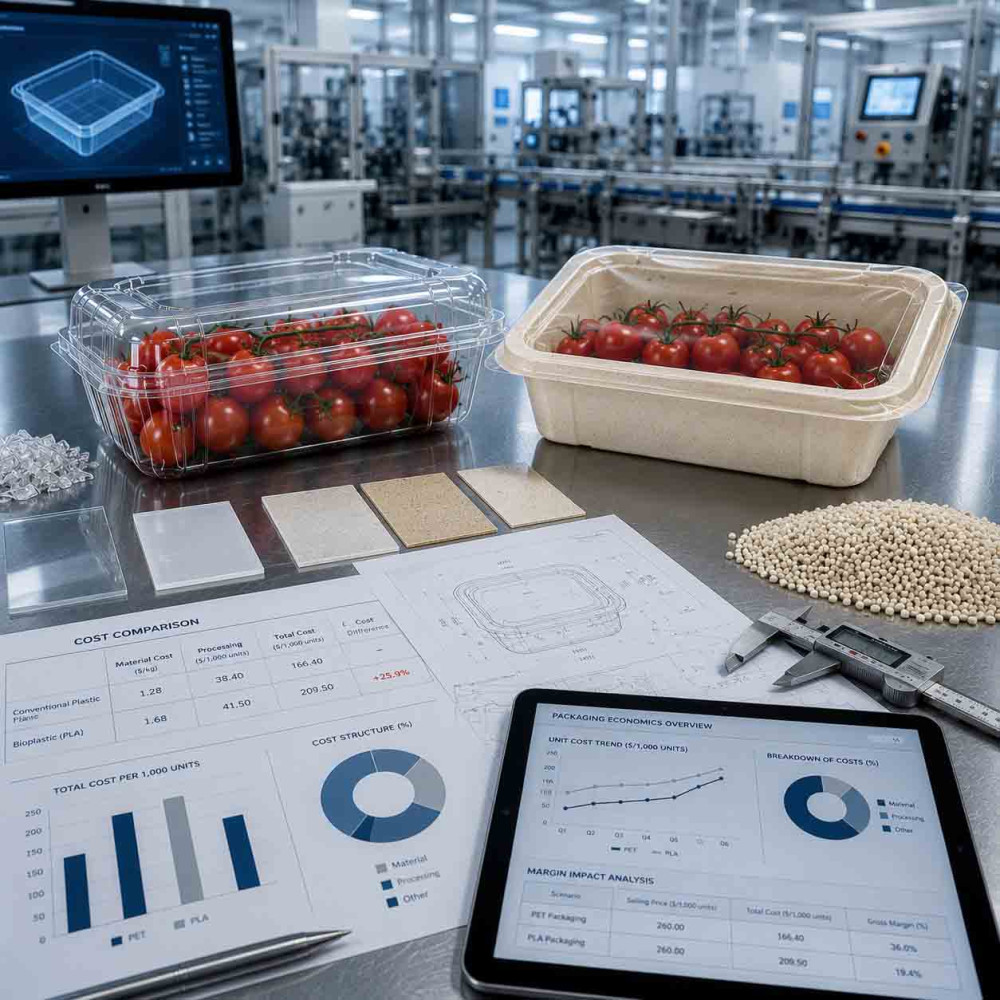
The biggest misconception is that bioplastics are simply a direct replacement for conventional plastics. In reality, their adoption involves additional costs that extend well beyond the price of the material itself. These include modifications to manufacturing processes, logistics adjustments, and potential losses in operational efficiency.
Bioplastics often require different storage and handling conditions, increasing operating expenses. Their limited production scale also contributes to higher costs, as manufacturing capacity has not yet reached the efficiency of conventional plastic production. As a result, the cost per unit of packaging is typically higher.
Taken together, these factors create a situation in which overall product costs increase while the ability to offset those costs through higher pricing remains limited. This makes it critically important to identify the situations in which these additional expenses can be economically justified.
Where Bioplastics Truly Deliver Value
The economic benefits of bioplastics are most evident in market segments where packaging has a direct influence on perceived product value. In premium categories, consumers are willing to pay more for sustainability, making eco-friendly packaging an integral part of the product rather than simply one of its features. In these cases, higher production costs can be offset by premium pricing.
Bioplastics are also effective in products with high added value, where packaging represents only a relatively small share of total production costs. This minimizes the impact on profit margins while allowing sustainability to become a meaningful point of product differentiation.
Another important factor is compliance with retail requirements. In categories where sustainable packaging has become the industry standard, adopting bioplastics provides access to retail shelves and reduces the risk of losing supply contracts. Under these circumstances, using bioplastics is no longer a competitive advantage—it becomes a business necessity.
Where Sustainable Packaging Undermines Business Economics
Challenges arise primarily in mass-market categories where consumers are highly price-sensitive. In these segments, even a modest increase in production costs can have a significant impact on profit margins, while the ability to raise prices remains limited. As a result, bioplastics become a factor that reduces profitability rather than enhances it.
Additional risks are associated with logistics and product shelf life. Some types of bioplastics offer lower barrier and protective properties than conventional materials, potentially leading to increased product losses and waste. This offsets the intended environmental benefits while placing additional financial pressure on the business.
Under these conditions, companies face a paradox: an environmentally responsible solution may actually weaken the economic sustainability of the business. This highlights the need to abandon a one-size-fits-all approach in favor of a selective implementation strategy.
Consumer Perception: Is the Market Willing to Pay?
Consumers consistently express support for environmentally friendly products, yet their purchasing behavior does not always reflect a willingness to pay more for them. In most cases, price and product appearance remain the primary purchasing criteria, while packaging plays only a secondary role.
This creates a gap between expectations and reality. Businesses invest in sustainable packaging expecting higher sales, but often fail to achieve the anticipated commercial results. Consequently, packaging becomes an additional expense rather than a source of added value.
A positive effect is observed only when sustainability is integrated into the overall product positioning. Without support from other product attributes, its influence on purchasing decisions remains limited.
Logistics and Shelf Life: Hidden Risks
Bioplastics affect not only packaging costs but also the physical performance of packaging materials. This directly influences product shelf life and resistance to external conditions. In some cases, it can result in higher product waste and a decline in product quality.
Logistics also become more complex. New materials may require different storage and transportation conditions, increasing operating costs. If these changes are not properly accounted for, the overall impact of switching to bioplastics can become negative.
For this reason, packaging should be viewed not only as a marketing tool but also as an integral part of the operational system. Ignoring this perspective can lead to hidden losses that are not immediately apparent.
Where Businesses Lose Money When Switching to Bioplastics
The greatest losses stem from the absence of a systematic approach. Many companies adopt bioplastics simply because they are a market trend rather than because they make economic sense. As a result, decisions are made without considering the specific characteristics of the product or its market category.
The most common mistakes include:
- using bioplastics in highly price-sensitive market segments;
- failing to account for logistics-related changes;
- overestimating consumers' willingness to pay;
- ignoring the impact on product shelf life.
These factors increase costs without generating a corresponding increase in revenue.
Bioplastics as Part of a System Rather Than a Standalone Solution
The key conclusion is that bioplastics are effective only when implemented as part of a broader business system. They must be integrated into the overall product strategy, logistics model, and sales approach. Without this integration, they simply become an additional cost.
In 2026, successful companies use sustainable packaging as a strategic business tool rather than an objective in itself. They implement it where it strengthens economic performance and avoid it where it undermines profitability. This enables them to maintain a balance between sustainability and financial success.
Bioplastics are not a universal solution. They become truly effective only when their implementation is based on a clear understanding of market dynamics and the underlying business model.
Your experience matters! Take a short survey and see how others answered. Take part