Introduction
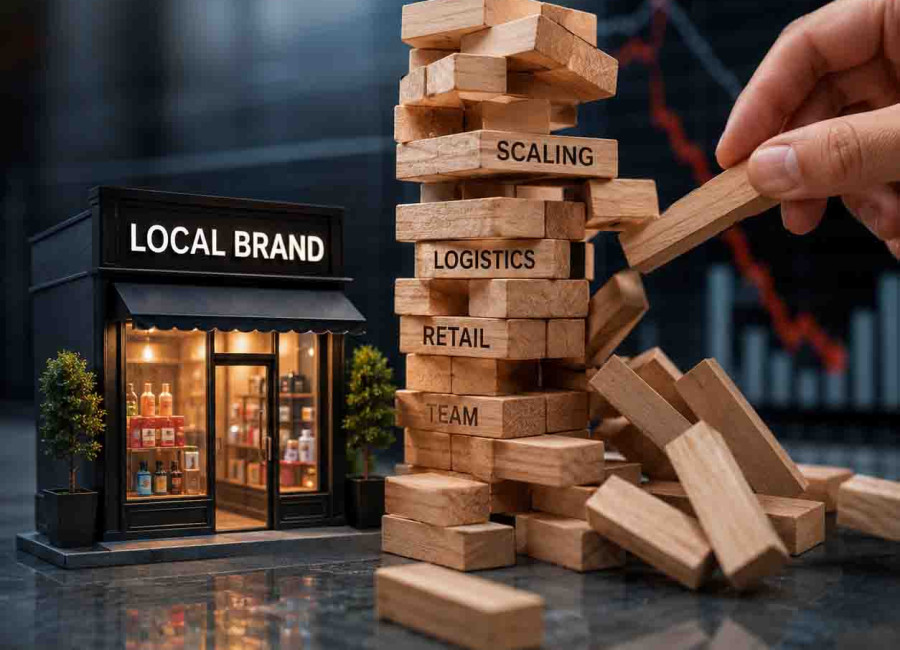
Why do brands that successfully sell at the local level, demonstrate stable demand, and maintain high customer loyalty begin to lose their position when scaling? Why does growth, which is expected to strengthen a business, instead lead to declining quality, shrinking margins, and brand dilution? In 2026, this problem is becoming systemic: local success is increasingly failing to transfer to a broader market.
The reason is that scaling is not an increase in the volume of an existing model, but a transition into a different system. A local brand operates under conditions of limited complexity, a short supply chain, and a high level of control. When entering new channels and increasing volumes, these parameters change, and the previous model stops being effective. This creates a gap between expectations and reality, which becomes the source of mistakes.
As a result, scaling turns into one of the riskiest stages of business development. Companies that fail to account for structural changes face a situation where growth destroys their key advantages.
Why Local Success Does Not Scale Directly
Local success is formed under conditions where the business maintains a high level of control over all elements: production, logistics, assortment, and customer communication. This makes it possible to react quickly to changes, maintain quality, and build a stable brand perception.
However, these conditions disappear during scaling. Increasing volumes lead to more complex processes, additional links in the chain, and higher requirements for consistency. This makes it impossible to preserve the previous level of control.
In addition, the structure of demand changes. A local audience may be more loyal and receptive to product specifics, while a broader market requires standardization. This creates a need for adaptation, which may contradict the original concept.
As a result, attempts to transfer a local model to a broader market without modifications lead to declining efficiency.
The Gap Between Product and System
One of the key mistakes is focusing on the product as the main success factor. Local brands often build their strategy around uniqueness, quality, or storytelling, which indeed works in a limited market.
However, during scaling, the product becomes part of a more complex system where not only its characteristics matter, but also the ability to ensure stability, availability, and compliance with channel requirements. This means that success is determined not by the product itself, but by the system supporting it.
If the system is not prepared for growth, even a strong product begins to lose market position. Problems with supply, quality, and availability emerge, reducing trust and affecting sales.
Logistics as a Breaking Point
Logistics becomes one of the most critical factors during scaling. Increasing volumes require a transition from a simple supply model to a more complex system involving warehousing, distribution, and inventory management.
Mistakes in logistics lead to disruptions that directly affect the business. Out-of-stock situations reduce sales, while excessive inventory increases losses. At the same time, these problems intensify as volumes grow.
In addition, variability increases. Different channels, regions, and conditions require adaptation, making management more difficult. Without a systematic approach, logistics becomes a source of instability.
Retail Pressure and Changing Conditions
When scaling, local brands encounter retail requirements that differ significantly from local market conditions. This includes participation in promotions, compliance with standards, and ensuring supply stability.
These requirements increase costs and reduce margins. At the same time, the brand loses part of its control over pricing and positioning because retailers manage shelf placement and promotion.
As a result, the business is forced to adapt to new conditions, which may contradict its original strategy. This creates an internal conflict between preserving identity and meeting market requirements.
Brand Dilution During Growth
One of the most noticeable effects of scaling is the change in brand perception. A local brand is often associated with authenticity, uniqueness, and closeness to the consumer. As expansion occurs, these characteristics become less pronounced.
This is linked to the need for standardization. To ensure stability and scalability, the brand is forced to simplify processes and adapt the product, reducing its uniqueness.
In addition, communication changes. The mass market requires different approaches, which may lead to the loss of the original positioning. As a result, the brand loses its identity.
Where Businesses Lose During Scaling
Losses do not arise from a single element, but from a combination of factors that intensify during growth. The main issue is that businesses underestimate the changes occurring during the transition to a more complex system.
Key areas of loss include:
• logistics disruptions
• declining margins
• loss of price control
• brand dilution
These factors lead to a situation where growth does not deliver the expected results.
Why Growth Becomes the Cause of Failure
The key problem is that growth does not create new mistakes — it scales existing ones. At the local level, many deviations remain unnoticed because they are compensated for by flexibility, manual management, and high involvement. However, as volumes increase, these same deviations begin to appear as systemic failures that cannot be eliminated without changing the model.
Growth increases pressure on all elements simultaneously: production, logistics, assortment management, and channel interaction. If even one of these elements is not prepared for scaling, it becomes a failure point for the entire system. Moreover, the problem rarely remains isolated — it spreads, creating a chain reaction that affects quality, availability, and financial performance.
An additional effect is accumulation. Mistakes that were previously isolated begin to repeat during growth, forming persistent losses. This may manifest itself in regular supply shortages, write-offs, declining margins, or deteriorating brand perception. As a result, the business faces not isolated issues, but a systemic decline in efficiency.
Most critically, growth creates the illusion of moving in the right direction. Increasing turnover is perceived as confirmation of strategy, which delays decisions about adjustments. As a result, the company continues scaling while reinforcing weak points until accumulated problems become critical. At this point, growth stops being an advantage and turns into a factor that destroys the business.
How the Approach to Scaling Is Changing
In 2026, scaling is no longer viewed as linear expansion and is increasingly perceived as a transition into a different operational reality. This means that before growing, a company must change not its volume, but its management structure, since this determines the system’s ability to withstand pressure.
A key element becomes business decomposition. Companies are beginning to analyze not overall growth, but its components: which channels generate profit, which create pressure, and which operations are bottlenecks. This makes it possible to abandon a universal approach and move toward selective scaling, where only the areas capable of sustaining growth without losing efficiency are strengthened.
In addition, the role of planning is changing. Instead of focusing solely on volume forecasts, companies begin to account for variability and risks. This leads to the creation of more flexible models where the system can adapt to deviations rather than collapse because of them. In this logic, resilience becomes more important than speed.
Process synchronization also gains particular importance. Production, logistics, and sales must function as a single system rather than separate functions. Without this synchronization, scaling creates misalignment, where growth in one element generates problems in another. This makes management more complex, but at the same time increases resilience.
As a result, scaling becomes a controlled process that requires preparation, analysis, and discipline. Companies begin to grow not faster, but more precisely, allowing them to maintain control over economics and avoid systemic failures.
Conclusion: Scaling as a Change of Model
The key conclusion is that scaling is not the expansion of an existing business, but a transition into a new model where the rules of operation change. Success in this model is determined not by the product and not by the speed of growth, but by the ability to build a system capable of handling increased pressure without losing quality or margins.
Within this logic, growth stops being an independent goal and becomes a tool that must be used within a controlled strategy. This requires businesses to evaluate not only the potential for increasing volumes, but also the consequences of this increase for the entire system. Every growth decision must be assessed through the lens of resilience, not only revenue.
It is especially important that the market is becoming less tolerant of scaling mistakes. While companies previously could compensate for deviations through flexibility or audience loyalty, under conditions of intense competition and standardized channels these opportunities are shrinking. This makes mistakes more visible and more expensive.
In 2026, the companies that succeed are those that perceive scaling as a process of transformation. They build systems in advance, adapt processes, and manage growth as a variable rather than as an inevitable stage. Those who continue to view growth as a simple increase in volume face a situation where their own success becomes the reason for declining efficiency. This is why scaling is no longer a guarantee of development, but a test of business maturity.
Your experience matters! Take a short survey and see how others answered. Take part