Latest Blog Posts
-

-

-

-

-

-

-

-

-

Why Successful Local Brands Fail When Scaling
May 25, 2026
-

Apr 06
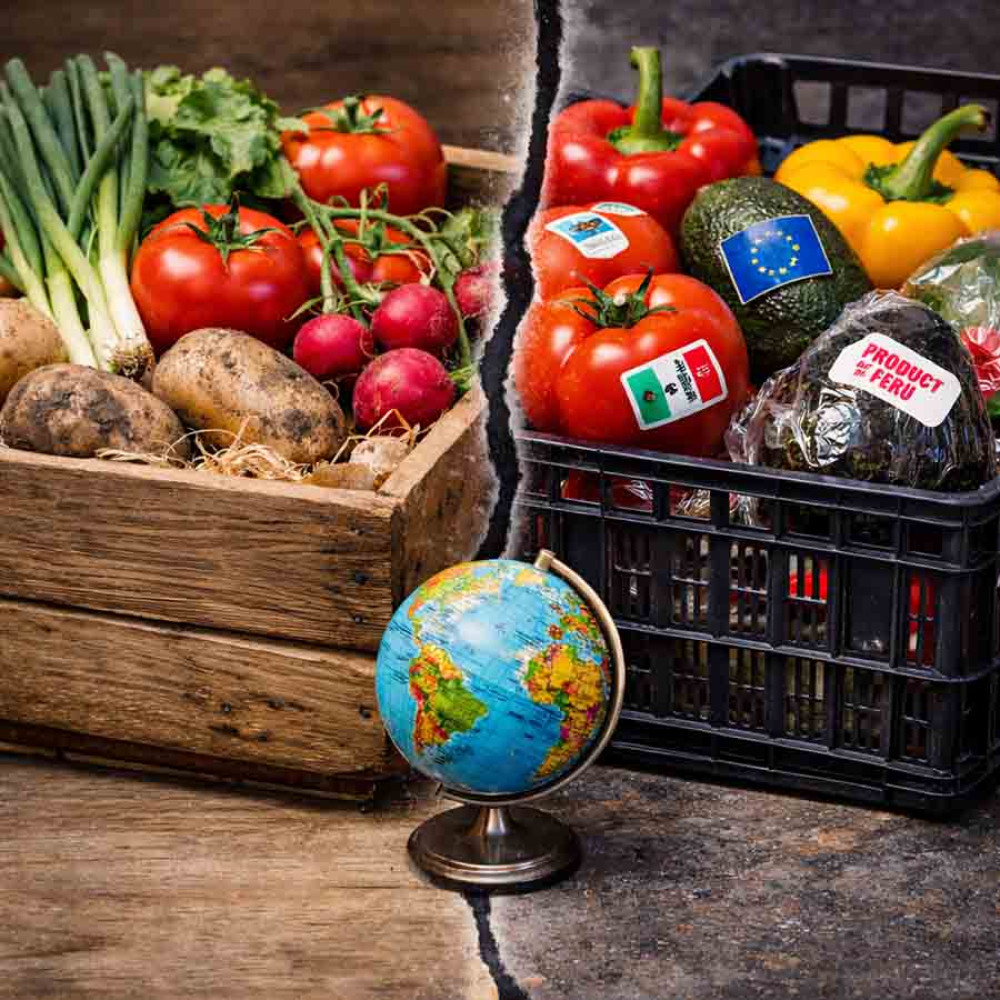
The Local Product Paradox: Why “Local” Doesn’t Always Beat Imports
Introduction
It may seem obvious that local products should outperform imported ones. They are closer, fresher, logistically simpler, and often perceived as more natural. However, in the reality of 2026, this assumption is becoming increasingly unreliable. In many fresh categories, imports continue to hold their positions and, in some cases, even displace local producers, despite the latter’s apparent advantages.
This paradox is not related to product quality, but to how the market is structured. Consumers do not choose “locality”; they choose predictability, appearance, price, and consistency. Retail, in turn, focuses not on origin but on economics: turnover, standardization, and supply chain manageability. As a result, local products operate within a system where their strengths do not always translate into sales.
Why “Local” Is Not a Competitive Advantage
The idea that proximity to the consumer automatically makes a product more attractive only works if other parameters are not weaker. In reality, local products often lose in terms of consistency and predictability, making them less convenient for retail and less clear for the consumer.
The core issue is that locality is not always visible on the shelf. Consumers do not analyze supply chains; they respond to visual and price signals. If a local product looks worse or costs more, its origin does not become a decisive factor.
Moreover, in an overloaded assortment environment, local products do not receive automatic visibility advantages. They compete on equal terms with imports and, without additional retail support, remain in low-attention zones.
Stability vs Seasonality: The Key Advantage of Imports
Imports win not because of distance, but because of predictability. Large suppliers build systems where products are delivered with consistent characteristics over extended periods. This is critical for retail, which depends on assortment stability.
Local producers often depend on seasonality and weather conditions, leading to fluctuations in quality and volume. Even with high product quality, this instability becomes a limitation, as retail cannot build long-term sales models on it.
As a result, imports are perceived as a more reliable option, despite longer supply chains. Stability outweighs distance because it reduces risks and simplifies category management.
Price as a Factor That Neutralizes “Local”
One of the key factors undermining the advantage of local products is price. Despite shorter logistics, local production is not always cheaper. This is связано with scale, technology levels, and process efficiency.
Import suppliers, operating at larger volumes and with optimized infrastructure, can achieve lower unit costs. This allows them to compete on price or maintain higher margins at comparable price levels.
For consumers, price remains a primary decision driver. If a local product is more expensive, its origin advantage must be obvious and meaningful. In most cases, this is not the case, and the choice shifts toward the more affordable option.
Visual Standards and Shelf Impact
The fresh category is highly dependent on visual perception. Retailers design shelves around standardization, as it simplifies decision-making and reduces risk. Imported products generally meet these requirements better due to more controlled production and sorting conditions.
Local products often show greater variability, which is perceived as deviation from the norm. Even if this variability reflects naturalness, at the shelf level it is interpreted as inconsistency. As a result, local products may appear less attractive and lose sales.
Placement also matters. Retailers tend to allocate the best shelf positions to products that ensure stable turnover. This reinforces the effect where imports receive more visibility, while local products remain in less advantageous positions.
Logistics: A Short Chain Is Not Always an Advantage
Intuitively, a shorter supply chain should benefit local products. In practice, however, the key factor is not length but manageability. Import suppliers design processes so that products move quickly and predictably through the chain.
Local logistics are often less standardized, leading to delays, supply instability, and quality fluctuations. This reduces retailer confidence and complicates planning.
As a result, a shorter chain does not always mean a fresher or higher-quality product. What matters more is how controlled and integrated the supply chain is.
Consumer Behavior: What Actually Drives Choice
In 2026, consumers make decisions quickly and do not treat product origin as a primary factor. They rely on visual perception, price, and habit. Locality may play a role, but only if it is clearly communicated and supported by other attributes.
In most situations, the choice is made between products perceived as comparable. If one is cheaper or looks better, it wins regardless of origin. This makes locality a secondary factor that only works in combination with other advantages.
Trust also plays a role. Imported products are often perceived as more standardized and predictable, reducing perceived risk. Local products must compensate for this through other signals, which are not always present.
Where Businesses Lose: Mistakes in Leveraging “Local”
One of the key mistakes is treating locality as a standalone advantage. Producers expect proximity to automatically generate sales without investing in other factors. As a result, the product becomes uncompetitive in terms of price, appearance, or consistency.
The second issue is the lack of systematic work with retail. Local products often do not receive sufficient shelf support, which reduces visibility and limits sales. Without managing placement, even strong products fail to realize their potential.
The third mistake is underestimating logistics and standardization. Supply and quality instability reduces trust and makes the product less attractive for retail. This leads to lost contracts and declining volumes.
Local Products as Part of a System, Not a Standalone Advantage
The key conclusion is that locality alone is not a success factor. It only works within a system where the product meets requirements in price, quality, consistency, and placement. Without this, it remains a characteristic that does not influence sales.
In 2026, the winner is not the one closest to the market, but the one best integrated into its structure. This means local producers must compete not on origin, but on efficiency. Only then can their advantages be realized.
The paradox of local products lies in the fact that their strengths become meaningful only within a systematic approach. Without it, they are lost within the broader market logic, where manageability—not distance—is the decisive factor.
Your experience matters! Take a short survey and see how others answered. Take part