Latest Blog Posts
-

-

-

-

-

-

-

-

-

Why Successful Local Brands Fail When Scaling
May 25, 2026
-

Apr 08
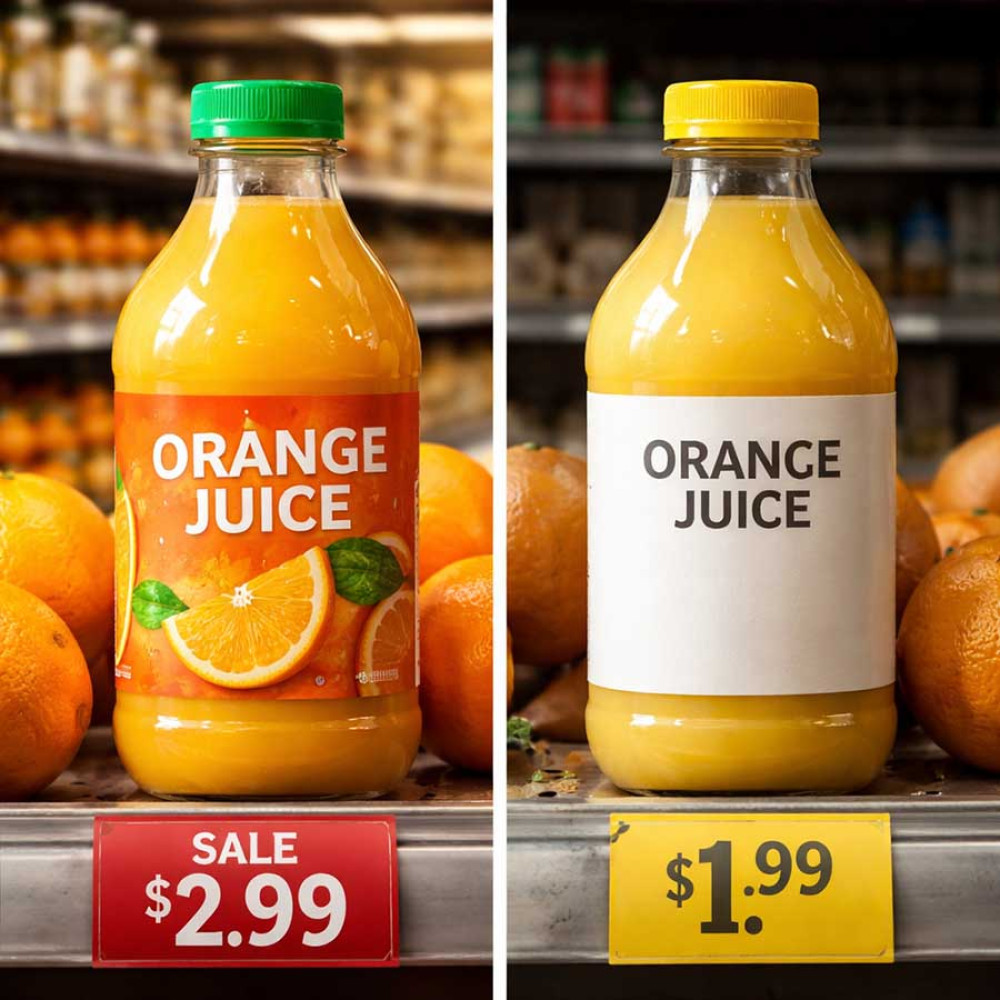
Why Identical Products Sell Differently: The Hidden Mechanics of Price Perception
Introduction
The food market in 2026 has definitively moved away from being a rational system in which consumers make decisions based solely on composition, quality, or even price. In practice, products with identical cost structures and functionality demonstrate radically different results in sales, margins, and turnover. This creates a paradox: a lower-priced product may lose to a more expensive alternative, and improvements in formulation do not necessarily lead to increased demand.
This shift is not driven by changes in the product itself, but by a transformation in the mechanics of perception. Price is no longer an absolute value; it has become an instrument of interpretation. In an environment of overloaded assortments, accelerated logistics, and retail dominance, consumers make decisions within limited attention spans and therefore rely on signals that are often unrelated to the actual characteristics of the product. This reshapes the entire category economics: success goes not to the one who produces better, but to the one who manages perception more precisely.
Price as a Signal, Not a Metric: Transformation of Consumer Logic
In the traditional model, price was perceived as a direct indicator of value. A higher price implied higher quality, while a lower price suggested compromise. In 2026, this logic has collapsed. Price is no longer merely a characteristic; it is a signal embedded within the context of the shelf, packaging, and assortment. The same price level can be perceived as “cheap,” “normal,” or “expensive” depending on its surroundings.
This is because consumers no longer compare products directly. They evaluate them within a micro-environment — a specific shelf, category, or even a visual block. Within this environment, perception anchors are formed: extreme values that define the range. For example, a product priced at $2 may appear advantageous if placed next to items priced at $4–5, and expensive if surrounded by products priced at $1–1.5. Thus, price loses its standalone meaning and becomes a function of context.
An additional factor is the decline in cognitive engagement. With high shopping speed and overloaded assortments, consumers do not analyze price as an economic category. They perceive it as part of a broader signal that includes packaging, brand, visual elements, and placement. As a result, a higher-priced product with “correct” positioning may be perceived as a better deal.
For businesses, this means that pricing can no longer be limited to cost and margin calculations. Price becomes part of a marketing construct, and its effectiveness depends on how well it is integrated into the perception system.
Packaging as a Pricing Tool
In an environment where consumers do not deeply analyze products, packaging becomes the primary carrier of the price signal. It forms the first — and often the only — impression of the product, determining the price category to which it belongs. As a result, packaging effectively begins to perform a function that previously belonged to price.
Strong packaging does more than attract attention; it defines the frame of interpretation. Materials, color palette, typography, and even the density of visual elements shape the perceived level of the product. Minimalist packaging with a “clean” design may be perceived as premium, even if the product inside is identical to a cheaper alternative. Conversely, overloaded or outdated packaging reduces perceived value regardless of actual quality.
The economic effect is reflected in the ability to manage price elasticity. A product with strong packaging is less sensitive to price, allowing for higher margins without losing sales volume. At the same time, weak packaging makes a product dependent on price competition, limiting growth potential.
Importantly, packaging does not work in isolation; it operates in conjunction with assortment and shelf positioning. The same design can produce different effects depending on its surroundings. This makes packaging management part of a broader system rather than a standalone tool.
Assortment as a Mechanism for Managing Choice
Modern assortment is no longer a reflection of demand diversity; it has become a tool for managing choice. A large number of SKUs within a category does not necessarily expand consumer options. On the contrary, it is used to create behavioral scenarios that guide the buyer toward specific products.
The key element of this system is the so-called assortment architecture. Within it, products are assigned roles: anchor items that define the price range; target products with maximum margin; and supporting SKUs that create the illusion of choice. As a result, consumers do not select from the entire assortment but move along a predefined trajectory.
One of the most effective tools is the creation of a “middle option.” When both a cheap and an expensive product are present, consumers tend to choose the intermediate option, perceiving it as optimal. This allows manufacturers and retailers to steer demand toward the most profitable items, even if they are not the best in terms of price or quality.
Assortment overload amplifies this effect. With too many options, consumers reduce the depth of analysis and rely on simple heuristics. This makes them more susceptible to signals embedded in the assortment structure. As a result, SKU management becomes not an operational task, but a strategic tool for influencing sales.
The Role of Retail: Control Over Context and Sales
By 2026, retail has firmly established control over the context in which product perception occurs. This means that even a strong product cannot realize its potential without proper placement and support. The shelf is no longer a neutral environment; it has become an active tool for demand management.
Product placement influences sales no less than price or packaging. Eye-level positioning, proximity to category leaders, participation in promotional blocks — all these factors shape the likelihood of selection. Retail uses these tools primarily to optimize its own margins rather than to promote objectively superior products.
Another factor is promotional dynamics. Frequent discounts and campaigns alter the perception of the base price, creating a “normalization” effect of discounts. As a result, products may only sell effectively under promotional conditions, losing their ability to generate profit in regular pricing scenarios. This is particularly critical for manufacturers who do not control placement conditions and must adapt to retail requirements.
Thus, control over context becomes a key resource. Manufacturers who fail to account for retail’s influence on price perception face situations where their products lose not because of quality, but because of incorrect shelf positioning.
Logistics and Price: A Hidden Link Shaping Perception
Logistics has traditionally been viewed as an operational function affecting cost. However, in modern conditions, it has a direct impact on price perception. Delivery times, availability stability, and the speed of assortment updates shape consumer expectations, which are then interpreted through price.
A product that is frequently out of stock loses trust regardless of its characteristics. Restoring that trust requires additional investment, including price reductions or stronger promotions. Conversely, consistent availability creates a sense of reliability, allowing for higher price retention.
Logistics speed also affects the perception of freshness and relevance. In categories with high sensitivity to shelf life, this becomes a critical factor. Faster supply chains reduce shelf inventory and improve product quality, which in turn increases consumers’ willingness to pay.
Finally, logistics determines the ability to manage assortment. Fast SKU turnover allows companies to test new products and adapt to demand changes. Slow logistics limits these capabilities, making businesses less flexible and more dependent on price competition.
Business Mistakes: Why the Right Product Fails to Sell
One of the key mistakes is focusing on the product as the main driver of success. Improvements in formulation, cost reduction, or quality enhancement do not guarantee sales growth if perception mechanisms are ignored. This leads to situations where product investments fail to pay off.
The second mistake is managing price in isolation. Companies often try to increase sales by lowering prices without considering context. As a result, the product may lose margin without a significant increase in volume, because its perception remains unchanged.
The third issue is ignoring assortment structure and SKU roles. Launching new products without understanding their function within the category leads to shelf overload and reduced efficiency. Instead of increasing sales, this creates internal competition and dilutes demand.
The fourth mistake is underestimating the role of retail. Manufacturers often view retail as a distribution channel rather than an active participant in demand formation. This results in insufficient attention to placement, promotions, and shelf interaction.
Together, these mistakes generate hidden losses that may not be immediately visible but significantly affect long-term business performance.
Practical Conclusions: How the Real Product Economy Works
The food market in 2026 operates as a system of interconnected factors in which the product itself is only one element. Price, packaging, assortment, retail, and logistics form a unified structure that determines outcomes. Ignoring any of these elements leads to distorted perception and reduced efficiency.
For businesses, this means transitioning from product-centric thinking to a systemic approach. Management must encompass not only production, but also the context in which the product is perceived. This requires coordination across functions, including marketing, sales, logistics, and retail collaboration.
The key insight is that consumers do not purchase the product itself. They purchase an interpretation formed by a set of signals. Managing these signals becomes the primary source of competitive advantage.
Your experience matters! Take a short survey and see how others answered. Take part