Latest Blog Posts
-

-

-

-

-

-

-

-

-

Why Successful Local Brands Fail When Scaling
May 25, 2026
-

Apr 03
Overloaded Market: Why 70% of New Products Fail to Survive
Introduction
In 2026, the food market has reached a point where launching a new product is no longer a growth tool and is increasingly becoming a source of hidden losses. The number of new SKUs continues to grow, yet their lifecycle is shrinking: a significant share of new products does not survive even their first year on the shelf. The issue is not the quality of the products themselves, but systemic changes in the market that make survival significantly more difficult for new entries.
Assortment overload, increased control from retail, and shifts in consumer behavior create an environment where a new product competes not only with existing items but also for the consumer’s limited attention. In such conditions, launching a product without considering category structure and shelf mechanics leads to a predictable outcome: the product fails to secure its position, does not generate repeat demand, and is eventually delisted. This makes analyzing the high “mortality rate” of new products critically important for businesses.
Assortment Overload as the New Market Norm
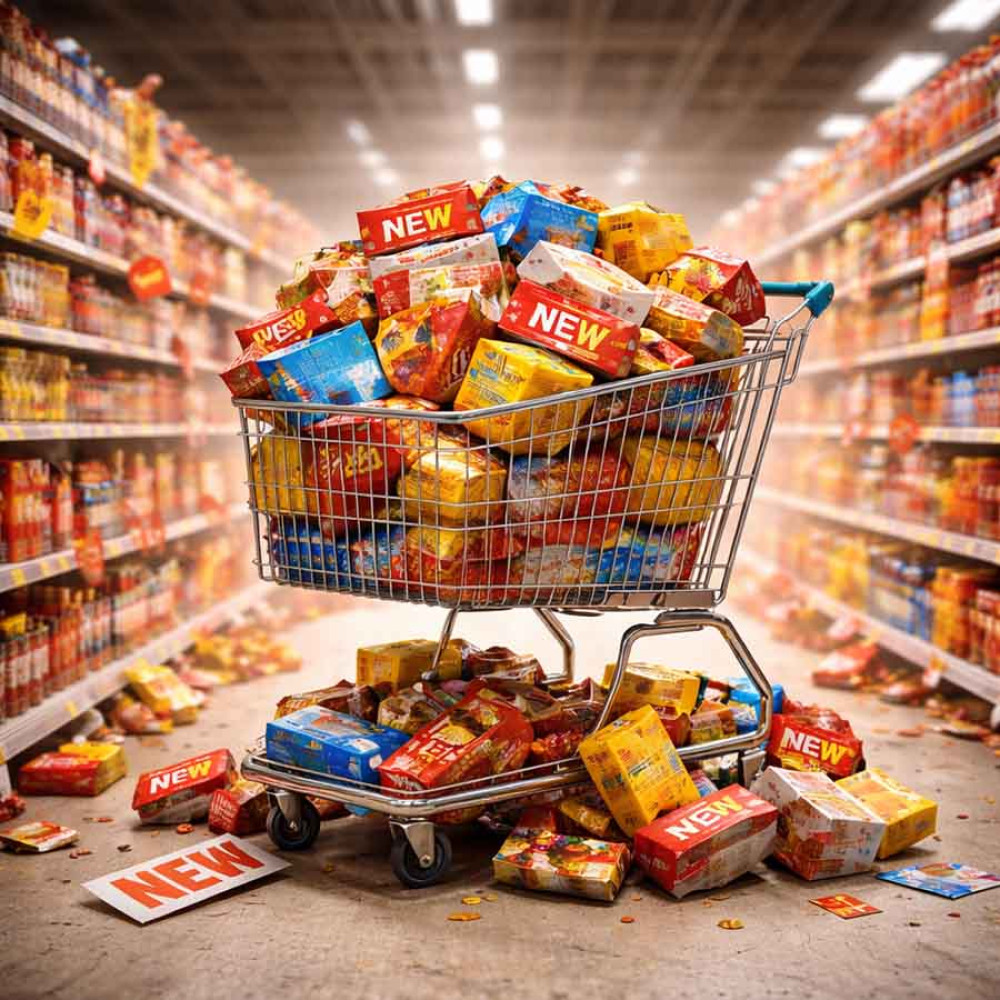
The growth in the number of SKUs within a category was initially perceived as a response to diverse consumer demand. However, in 2026, it has become an independent factor affecting sales efficiency. Assortment overload reduces the visibility of each individual product, as both physical shelf space and consumer attention remain limited. As a result, even high-quality new products operate in conditions where they simply go unnoticed.
The problem is compounded by the fact that assortment expansion is not accompanied by proportional demand growth. This leads to sales being redistributed across a larger number of products, reducing turnover for each of them. In such an environment, retailers actively optimize their assortment, removing low-performing items. New products that have not yet established themselves become the first candidates for delisting.
An additional effect arises from internal competition within a brand. When launching new SKUs, companies often fail to consider that they may cannibalize sales from existing products. This creates an illusion of growth at launch, but in reality leads to demand dilution and reduced efficiency across the entire product line.
Consumer Behavior: Limited Attention and Fast Decisions
Modern consumers operate in an overloaded information environment where decision-making time is minimal. This leads to simplified choice models based on habit, visual cues, and recognition. New products, lacking an established consumption history, are at a disadvantage.
Consumers do not actively seek to explore new products. Instead, they tend to avoid risk and choose familiar items that have already proven reliable. Even when there is interest in a new product, the purchase decision is often postponed and then lost within the broader flow of choices. This reduces the likelihood of an initial purchase, without which repeat demand cannot form.
In a context of limited attention, a new product must not only be present on the shelf but must instantly communicate its value. If it fails to do so, it remains unnoticed regardless of its actual qualities.
Declining brand loyalty further reinforces this dynamic. Consumers switch more easily between products but are not willing to invest time in exploring new options. This creates a paradox: the market is open to change, yet new products do not receive enough attention to establish themselves.
The Role of Retail: Assortment Filtering and Pressure on New Products
In 2026, retail acts as an active filter determining which products remain on the shelf. Limited space and the need to maintain high turnover force retailers to strictly control assortments. New products are treated as temporary items that must quickly prove their efficiency.
If a product fails to demonstrate sufficient sales within a short period, it is delisted. This shortens the window of opportunity for market establishment and increases the requirements for initial performance. Manufacturers who fail to account for this dynamic face situations where products do not have time to gain traction.
Retail evaluates not the potential of a product, but its actual sales performance. This means that even promising new items can be removed if they fail to deliver quick results.
An additional factor is dependence on promotions. New products often require support through discounts and promotional campaigns, which reduces their margins and creates expectations of lower prices. As a result, a product may only perform under promotional conditions, making it economically unstable.
Launch Mistakes: Where Businesses Lose the Product Before Market Entry
The high failure rate of new products is largely driven by mistakes made during the launch phase. One of the key issues is the lack of a clearly defined role within the category. Companies introduce new products without determining the specific task they are meant to solve: attracting new consumers, increasing basket size, or strengthening brand positioning.
Another common mistake is overestimating uniqueness. Manufacturers often assume that a new flavor or format will automatically generate demand. However, in an overloaded market, such changes are not perceived as meaningful. Without clear positioning, the product gets lost among similar offerings.
Launching without understanding the category structure turns a new product into just another SKU rather than a growth tool.
The importance of synchronization with retail is also often underestimated. Lack of agreements on placement, promotions, and support leads to the product starting under unfavorable conditions. This significantly reduces its chances of a successful launch.
The Economics of New Products: Hidden Losses and the Illusion of Growth
Launching new products is often perceived as a sign of company development. In reality, however, it is associated with significant costs that do not always pay off. Product development, production, marketing, and logistics create substantial pressure on the budget.
Short-term sales growth may create an illusion of success. A new product attracts attention and generates initial sales, but without sustained demand, this effect quickly fades. As a result, the company is left with accumulated costs and no long-term return.
Most new products do not fail immediately—they gradually lose sales, creating hidden losses.
Additional costs arise from increased assortment complexity. A higher number of SKUs raises operational expenses, including storage, logistics, and inventory management. This reduces overall business efficiency, even if individual products show acceptable performance.
The Impact of Price and Logistics on Product Survival
Price and logistics play a critical role in the fate of new products. In a highly competitive environment, a product must align with price expectations shaped by the category. Deviations in either direction reduce purchase likelihood: a price that is too high is perceived as risky, while a price that is too low signals poor quality.
Logistics determines product availability. Unstable supply or absence on the shelf at key moments reduces the chances of habit formation. Even a successful launch can fail if logistics issues disrupt product availability.
A product that does not generate repeat purchases within the first weeks has almost no chance of survival.
The speed of assortment renewal also affects survival. In an environment where retailers constantly test new products, the window for establishment becomes shorter. This requires manufacturers to react quickly and manage supply with precision.
The Overloaded Market as a System: Where Product Survival Is Determined
The modern food market operates as a system where the success of a new product is determined not by a single factor, but by the interaction of multiple elements. Product characteristics, price, packaging, placement, logistics, and consumer behavior form a unified model within which purchasing decisions occur.
The key conclusion is that product survival depends on its ability to integrate into this system. A new product must not only be high quality but must occupy a clear position within the category, meet price expectations, and receive retail support. Without this, even a strong product will fail to establish itself.
The market no longer tests products—it tests their ability to function within the system.
For businesses, this means rethinking the approach to product launches. Success is no longer defined by the number of launches, but by the precision of their integration into the market. Companies that continue to view new products as the primary growth driver face rising costs and declining efficiency. Those who manage assortment structure and context gain a sustainable competitive advantage.
Your experience matters! Take a short survey and see how others answered. Take part